SAN CLEMENTE, Calif. — November 11, 2026 — For generations, San Clemente’s beaches have defined the city’s identity, attracting surfers, families, visitors, and residents who cherish its reputation as the Spanish Village by the Sea. But as erosion continues to consume stretches of shoreline, the community faces a question that is becoming increasingly difficult to ignore: How much longer can San Clemente protect both its beaches and the railroad running alongside them?
A major decision last week may offer part of the answer.
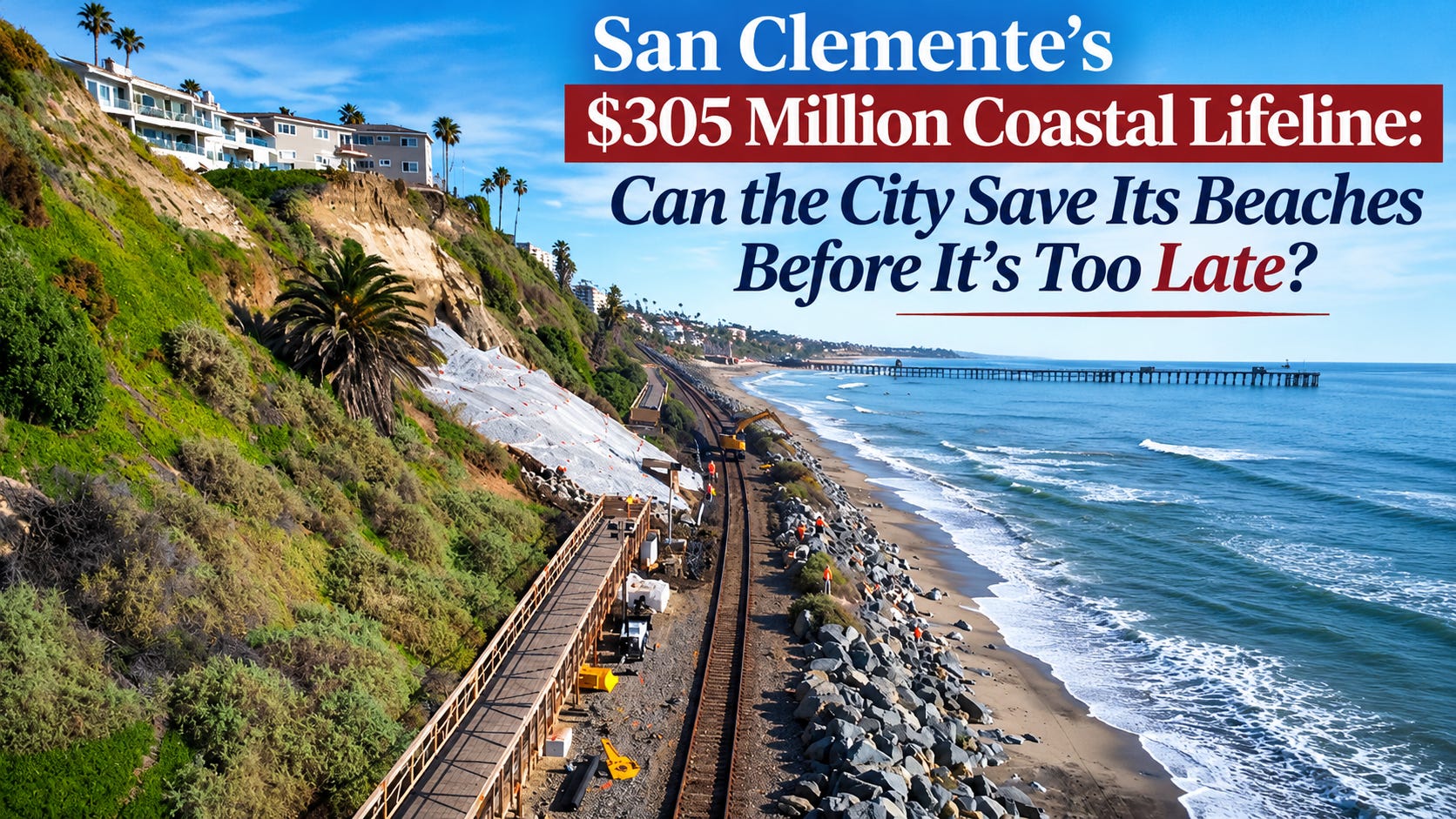
On November 5, the California Coastal Commission unanimously approved an extensive shoreline protection and sand replenishment project proposed by the Orange County Transportation Authority (OCTA). The initiative includes approximately 690,000 cubic yards of sand for San Clemente’s coastline, representing one of the region’s most significant beach restoration efforts in decades.
The broader rail protection program has secured approximately $305 million in state and federal funding, including roughly $100 million committed to sand replenishment and public access.
For San Clemente, the stakes extend well beyond transportation.
A Coastline Under Pressure
San Clemente’s beaches have experienced years of erosion, with some stretches of shoreline narrowing dramatically or disappearing altogether.
The railroad, which connects San Diego with Orange County and destinations farther north, has suffered repeated closures since 2021 as landslides, unstable bluffs, and powerful waves have threatened the tracks.
These disruptions affect commuters, tourists, freight transportation, and military logistics. But they also illustrate a more fundamental challenge: The infrastructure built along San Clemente’s coast increasingly competes with the natural movement of its beaches.
Historically, transportation agencies have relied on large boulders, known as riprap, to shield the railroad from encroaching waves. Although these barriers can protect infrastructure in the short term, critics argue that they can accelerate the disappearance of sandy beaches.
The newly approved project attempts to balance those competing interests by combining engineered shoreline protection with substantial sand replenishment.
Under the proposal, approximately 240,000 cubic yards of sand would be placed around North Beach and Mariposa Point, with another 450,000 cubic yards directed toward San Clemente State Beach.
A Major Investment, but No Immediate Solution
The Coastal Commission’s approval represents a significant regulatory milestone, but residents should not expect the coastline to be transformed overnight.
Construction schedules, environmental requirements, and logistical challenges could delay sand placement, potentially leaving portions of the coast vulnerable during the coming winter storm season.
The approval also comes with important conditions, including a 10-year permit term and a five-year review.
These requirements reflect a growing recognition that coastal protection cannot be treated as a one-time construction project. Beaches are dynamic environments, and even substantial sand replenishment efforts require ongoing monitoring and maintenance.
Meanwhile, the long-term future of the railroad remains unresolved.
Transportation officials are examining alternatives that could eventually include relocating the tracks inland, an undertaking that would involve substantial financial, environmental, and engineering challenges.
Voters Face Difficult Choices
The Coastal Commission’s decision follows a contentious local debate over how San Clemente should finance its coastal future.
Measure M, a proposed one-percentage-point local sales tax increase intended to help fund beach preservation and wildfire protection, appeared headed for defeat following the November 3 election, with approximately 63% of voters opposing it in results reported November 9.
The apparent rejection highlights an important distinction: Residents may strongly support restoring their beaches without necessarily agreeing on how to pay for that restoration.
State and federal funding can provide substantial assistance, but San Clemente will still need to confront the question of how to finance coastal maintenance over the coming decades.
That debate will likely become more consequential as erosion continues and the costs of protecting existing infrastructure increase.

More Than a Transportation Issue
For San Clemente, the future of its coastline is inseparable from the future of its local economy.
Beaches support tourism, recreation, hospitality, and businesses throughout the community. They also provide public spaces that make the city attractive to residents and visitors alike.
The loss of accessible sandy shoreline carries consequences that cannot be measured solely in construction costs or railroad service interruptions.
Restoring the beaches could help protect the community’s economic vitality while preserving a defining feature of its identity.
Yet the project also raises difficult questions about the appropriate balance between protecting existing infrastructure and preserving public access to the ocean.
Some coastal advocates have argued that railroad protection measures should include stronger guarantees that sandy beaches remain accessible to the public.
Those concerns deserve consideration as the project advances.
The Next Chapter for the Spanish Village by the Sea
San Clemente’s coastal challenges did not emerge overnight, and they will not disappear with a single permit approval.
The newly authorized project represents meaningful progress toward protecting the railroad and replenishing portions of the shoreline. But its ultimate success will depend on implementation, continued funding, and the ability of public agencies to adapt as coastal conditions change.
The coming months will be particularly important as officials prepare for additional storms and work toward delivering sand to the city’s most vulnerable beaches.
For residents, the central issue is straightforward.
San Clemente has spent nearly a century building its identity around the Pacific Ocean. Preserving that relationship for future generations will require more than emergency repairs.
It will require a lasting commitment to the beaches that make San Clemente home.